Two Paths to Earlier Detection: Nathan Fernandes and Racheal Wangari Build Toward a New Tool for Environmental Safety
The junior researchers combined molecular biology, bioinformatics, physics, and engineering to advance complementary approaches for detecting harmful microorganisms before they threatened terrestrial or aquatic environments.
Bristol, RI (11/02/2026) — Before a sensor can detect a harmful microorganism in nature, researchers first have to know precisely what genetic signature tells them they have found the right species.
For juniors Racheal Wangari and Nathan Fernandes, those two challenges became interconnected pieces of a summer spent working toward a faster way to detect Pseudo-nitzschia delicatissima, a marine diatom associated with domoic acid and amnesic marine life poisoning.
Wangari, a Biology major with Mathematics and Physics minors who is part of the Honors Program and pursuing a Biotechnology Certificate, focused on identifying species-specific genetic sequences that could distinguish P. delicatissima from closely related organisms.
Fernandes, a Biochemistry major with Mathematics and Physics minors who is also pursuing a Biotechnology Certificate, worked on the other side of the problem: developing and testing an electrochemical genetic nanosensor capable of translating a genetic match into a measurable electrical response.
After weeks spent identifying sequences and developing a functional circuit, he added , finally observing distinguishable signals between complementary and non-complementary DNA, provided the first evidence that the approach could work.
Although the students pursued separate research questions, their projects were connected.
"The two parts of the projects are different, [but] they are both dependent on each other," they said.
Finding the Right Genetic Signature
Wangari's project, "Designing Molecular Gene Probes Using Bioinformatics and Molecular Tools to Detect the Presence of Pseudo-nitzschia delicatissima," began with a practical question: How do you identify a piece of DNA that belongs to the organism you want to detect without mistaking it for one of its close relatives?
Using sequence information from NCBI GenBank, Wangari examined regions of large-subunit ribosomal RNA and compared genetic sequences across related Pseudo-nitzschia species. She focused on identifying small differences that could potentially serve as molecular fingerprints.
After selecting candidate sequences, she aligned them against corresponding regions in related species, looking for differences of one to three base pairs that could eventually allow a sensor to distinguish its intended target.
She then designed primers and used polymerase chain reaction, or PCR, to amplify a roughly 500-base-pair region containing promising targets.
Getting there took time.
Wangari first had to identify the region, design primers that met the necessary requirements, order the DNA and primers, and develop an amplification protocol. When she finally saw that the PCR had successfully amplified the target region, the result opened the door to the next phase of the project.
Her next steps include further testing to determine which candidate sequences offer the best combination of specificity and effectiveness for eventual use in the genetic nanosensor.
Turning DNA Recognition Into an Electrical Signal
Once researchers know what genetic sequence they want to recognize, Fernandes' project asks how that recognition can be measured.
His project, "Development of an Electrochemical Genetic Nanosensor for the Detection of Pseudo-nitzschia delicatissima," uses a gold electrode coated with gold nanoparticles and species-specific probe DNA. Methylene blue serves as a redox indicator, allowing researchers to measure changes in electrical current when target DNA interacts with the probe.
The principle is based on complementary DNA binding.
When complementary target DNA successfully hybridizes with the probe, it forms double-stranded DNA that changes how methylene blue interacts with the electrode. A non-complementary sequence behaves differently, creating a distinctive electrical response.
Fernandes and Wangari's work produced distinguishable current signals between complementary and non-complementary samples, with their experiments demonstrating differentiation down to a concentration of 1 micromolar.
Fernandes also worked on the circuit used to perform the voltage sweep and measure those responses.
His academic background proved particularly useful.
Physics helped Fernandes understand the relationship among the working, counter, and reference electrodes and how methylene blue participates in the electrochemical reaction. Biochemistry informed his understanding of DNA hybridization, while Mathematics became useful when analyzing the resulting data through coding.
When the First Answer Is No
Progress did not come in a straight line.
During their first tests of complementary and non-complementary DNA, the students saw no meaningful difference between the electrical signals.
Rather than indicating the idea had failed, the result sent them back to the experimental conditions.
Fernandes and Wangari investigated whether the complementary DNA was successfully hybridizing with the probe and began refining the conditions needed to encourage that binding.
Wangari said another early challenge was assuming that the sensor's scan rate was the primary variable responsible for inconsistent results. Even after repeatedly adjusting it, the problem remained.
With guidance from their faculty mentor, Professor of Biology Avelina Espinosa, the students recognized that the sensor depended on a much larger system of interacting variables, including the concentrations of probe DNA, methylene blue, and gold nanoparticles.
"All these properties, both individually and all together, affect how the genetic nanosensor works," Wangari said.
That process became part of the research lesson itself: a result that does not work as expected can still narrow the possibilities and point toward the next experiment.
The students also drew on one another's strengths.
Wangari developed bioinformatics protocols, identified probe sequences, designed primers, and worked with techniques including PCR and TOPO cloning. Fernandes brought more experience interpreting circuit diagrams after completing Physics II and applied that background to development of the genetic nanosensor circuitry.
Together, they said, those complementary skills allowed them to accomplish more than either project could have independently.
The interdisciplinary project was conceptualized by Professor Espinosa, a molecular microbiologist and biotechnologist, who assembled a team including Associate Professor of Physics Jennifer Pearce, who provided training in nanoparticle platform design, and Assistant Professor of Electrical Engineering Allison Marn, who led the electrochemical detection design. The project is sponsored by the National Science Foundation Rhode Island Inclusive Network for Excellence in Science and Technology RI-NEST.
From the Lab to the Field
The ultimate ambition reaches beyond proving that a sensor can differentiate two DNA samples in a laboratory.
Pseudo-nitzschia species can produce domoic acid, which can accumulate in marine organisms and create risks for shorebirds, mammals, and people who consume contaminated seafood. Harmful algal blooms, like those caused by P. delicatissima, are being exacerbated by climate change and causing diseases and death in the world's oceans.
Fernandes and Wangari hope future versions of the technology could allow researchers to monitor terrestrial and aquatic environments and detect harmful microorganisms earlier and more efficiently than existing approaches.
Earlier detection could help environmental safety and public health officials to respond more quickly to harmful algal blooms and prevent major impacts, they suggested. It could also reduce the risk of contaminated seafood reaching consumers and support a faster, more cost-effective approach to water-quality monitoring.
While environmental safety provides an application for the research, Espinosa explains that by replacing the molecular probe with sequences of other pathogens, new versions of the genetic nanosensor could be used to detect Naegleria, sometimes referred to as the "brain-eating amoeba," as well as Acanthamoeba, Giardia, Cryptosporidium, and Entamoeba in environments ranging from lakes and rivers to swimming pools and contaminated food or water. Such adaptability could give the technology a direct application in public health by supporting earlier detection of harmful microorganisms.
There is still considerable work ahead.
Fernandes said researchers need to continue optimizing the conditions that allow complementary DNA to hybridize with the probe so the electrical difference between matching and non-matching sequences becomes as clear and reliable as possible before the technology could realistically move into field use.
Wangari likewise emphasized that bioinformatics can identify promising genetic targets, but laboratory testing is still necessary to prove that those sequences are sufficiently specific and effective.
For both students, that unfinished work is part of what makes the project compelling.
Research That Sparks the Next Question
Wangari's 10-week experience was supported by the Mark Gould Research Fellowship, which provided a stipend that allowed her to remain on campus and devote the summer to research.
"The fellowship allowed me to make the most of this experience both academically and professionally," she said, noting that the support gave her time to build laboratory and problem-solving skills without the additional financial pressure of covering summer living costs.
The experience also strengthened her interest in biomedical science and in pursuing biotechnology or molecular biology professionally. She is considering graduate study, including a potential master's program in Biotechnology at RWU.
Fernandes also received support for his summer research as a National Science Foundation Rhode Island Summer Undergraduate Research Fellow through RI-NEST, a 10-week program that provided a stipend and support for project supplies.
For Fernandes, that experience placed him at the intersection of fields that are usually encountered separately in coursework: biology, chemistry, mathematics, physics, bioinformatics, and electrical engineering.
That interdisciplinarity was not incidental to the research. It was what allowed the project to work. Wangari had to determine what genetic sequence the system should recognize, while Fernandes had to help determine how that recognition could be measured electronically.
And together, their work moved the larger project one step closer to a future in which identifying potentially harmful terrestrial or marine microorganisms might begin not with waiting for contamination to become a problem, but with detecting their genetic signature before it does.
Media Attachments
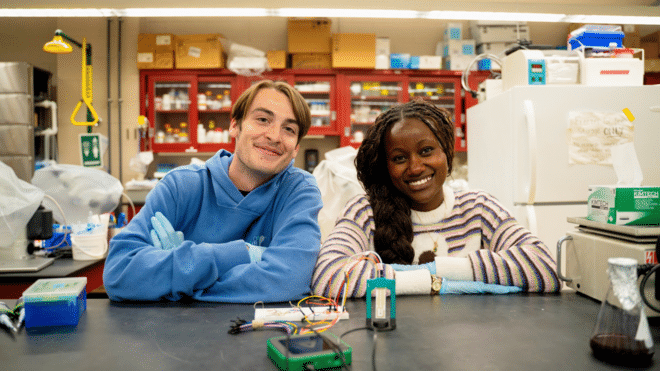
Juniors Nathan Fernandes and Racheal Wangari work together in the Marine and Natural Sciences Building, where their complementary research combines molecular biology, bioinformatics, physics, and engineering to develop a new approach for detecting harmful microorganisms.